
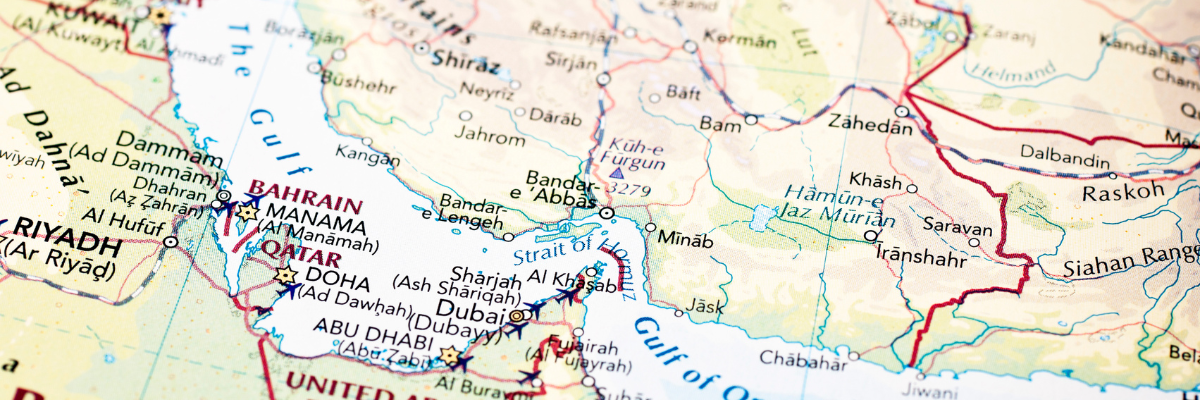
Recent geopolitical tensions involving Iran have brought renewed attention to the Strait of Hormuz, one of the most strategically important maritime passages in global trade. At the same time, ongoing attacks on commercial vessels in the Red Sea by Houthi militants have already forced many carriers to reroute ships away from the Suez Canal.
For logistics professionals, these two issues are not separate stories—they are part of the same broader shipping corridor that connects Asia, the Middle East, and Europe.
Understanding how these chokepoints interact is essential for supply chain planning.
The World’s Most Important Maritime Corridor
A significant portion of global trade travels through a connected chain of waterways linking the Persian Gulf to Europe and the Mediterranean.
This route typically includes:
- The Strait of Hormuz, the gateway between the Persian Gulf and the global oceans, is critical for oil and LNG shipments.
- Arabian Sea transit, where vessels move toward the Gulf of Aden.
- The Bab el-Mandeb Strait connects the Arabian Sea to the Red Sea.
- Red Sea transit, leading north toward Egypt.
- The Suez Canal is the shortest maritime route between Asia and Europe.
When disruptions occur in any one of these locations, the entire corridor can feel the impact.
Visual Guide: The Middle East Shipping Chokepoints
MAP OR GRAPHIC HERE
Global Trade Route Overview
Persian Gulf
↓
Strait of Hormuz – Major oil and LNG shipping lane
↓
Arabian Sea
↓
Bab el-Mandeb Strait – Entry point to the Red Sea
↓
Red Sea – Recent Houthi attack zone affecting container vessels
↓
Suez Canal – Key connection between Asia and Europe
↓
Mediterranean / European Ports
Alternative route when disruptions occur:
Asia → Cape of Good Hope (South Africa) → Europe
This detour can add 10–14 days or more to transit times.
Why the Strait of Hormuz Matters
The Strait of Hormuz is one of the most critical shipping chokepoints in the world.
Key factors include:
- Approximately one-fifth of the world’s petroleum supply moves through the strait each day.
- The route supports major energy exports from Saudi Arabia, Qatar, the UAE, Kuwait, Iraq, and Iran.
- LNG shipments from Qatar—one of the world’s largest suppliers—depend heavily on this passage.
Because there are few practical alternatives, instability in the strait can quickly influence global energy prices and shipping markets.
Red Sea Disruptions Are Already Affecting Global Shipping
While the Strait of Hormuz faces rising geopolitical tension, the Red Sea shipping crisis has already disrupted major container routes.
Since late 2023, attacks on commercial vessels have caused:
- Major ocean carriers to reroute ships around the Cape of Good Hope.
- Transit times between Asia and Europe are expected to increase.
- Global container capacity to tighten.
- Fuel costs and freight rates are expected to fluctuate.
When both regions experience instability simultaneously, pressure on global shipping networks increases.
Did You Know?
How These Two Regions Are Connected
The Strait of Hormuz and Red Sea disruptions are linked both geographically and politically.
- Shared trade corridor, vessels traveling between Asia and Europe often pass through both regions on the same voyage.
- Strategic chokepoints, Hormuz and Bab el-Mandeb, are two of the most important maritime bottlenecks in the world.
- Regional geopolitical overlap, tensions involving Iran often intersect with broader Middle East security dynamics.
- Compounding supply chain effects, instability in multiple locations increases the likelihood of rerouting, congestion, and higher freight costs.
For logistics planners, this means disruptions can spread quickly beyond a single region.
What Shippers Should Watch
Supply chain teams should monitor several key indicators in the coming weeks:
- Ocean carrier routing announcements
- Maritime security advisories
- Changes in war-risk insurance premiums
- Energy price volatility
- Vessel traffic patterns through the Suez and the Cape routes
Even when routes remain open, uncertainty can influence shipping schedules and capacity planning.
How Everglory Logistics Helps Customers Navigate Disruptions
At Everglory Logistics, we closely monitor global geopolitical developments that may affect freight movement and carrier routing.
Our teams work with international partners to:
- Track shipping lane disruptions in real time
- Provide early updates on routing changes
- Identify alternative transportation solutions
- Help customers maintain supply chain continuity
In today’s global logistics environment, staying informed and flexible is critical.
Planning Ahead in Uncertain Times
Maritime trade has always depended on a small number of strategic waterways. When those chokepoints face disruption, the effects can ripple through global supply chains.
By monitoring developments in the Strait of Hormuz and the Red Sea, logistics teams can better anticipate risks and adjust shipping strategies accordingly.
If your cargo may be affected by Middle East routing changes, contact Everglory Logistics to explore alternative solutions and keep your shipments moving.